
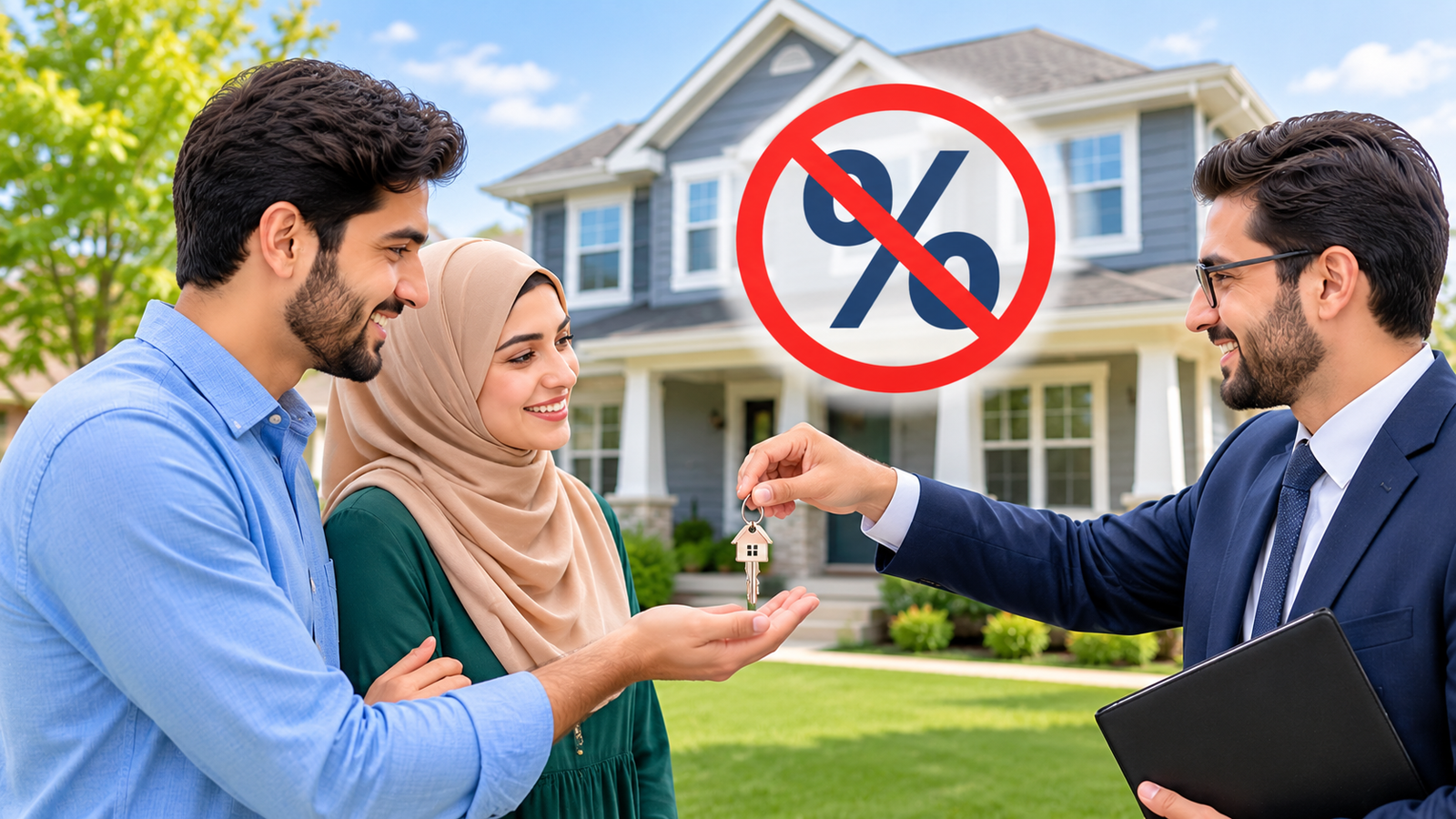
Yes, you can buy a house without interest in the United States. Most families do it with cash, with halal home financing, or with a carefully built seller deal.
Each path has real costs. None of them is free money, and each one has rules you should know before you sign.
This guide explains every option and what it costs in Virginia. It also shows which path tends to fit which buyer.
Can you really buy a house without interest?
Yes. US law allows home purchases that never involve an interest-bearing loan. To buy a house without interest, you can pay cash or use halal home financing. You can also buy from a seller who accepts a fixed price paid over time. Every route still carries closing costs, property taxes, and insurance.
Interest on a loan is what Islam calls riba. Many Muslim buyers want to avoid it fully. Some buyers of other faiths simply want to stay out of debt.
The US system has room for both. Federal bank regulators approved lease and cost-plus home financing in 1997 and 1999. That opened the door for interest-free home purchases at scale.
Cash is the cleanest path. It is also the hardest.
Paying cash is the simplest way to buy a house without interest. There is no lender, no monthly payment, and no riba. You own the home outright on closing day.
Cash also makes your offer stronger. There is no financing contingency and no lender appraisal to slow things down. Cash buyers made up 27 percent of US home sales in September 2026, says the National Association of Realtors.
The hard part is the price. The national median existing home price was $417,500 that month, and many Northern Virginia homes cost more.
Some families pool money with parents or siblings to get there. If you do, put the deal in writing and title the home correctly. A real estate attorney can draft a shared ownership agreement.
Family loans need care too. The IRS has rules for large family loans made below market rates. Talk to a tax professional before you lend or borrow.
How does halal home financing avoid interest?
Halal home financing replaces the loan with a contract tied to the house. The provider resells the home at a fixed markup or leases it to you. Or it owns the home with you while you buy out its share. It earns a profit rate instead of interest, and the payment often lands close to a bank loan.
This is the most common way to buy a house without interest when cash is not enough. You still make a down payment and a monthly payment. The contract simply earns money from the property, not from lending.
Freddie Mac began buying these contracts in 2001, which helped providers grow. Our guide on how a halal mortgage works in Virginia walks through each step. Our side-by-side guide to the two oldest models compares them in detail.
Can a seller finance you without interest?
Sometimes. A seller can agree to a set price that you pay in installments, with no interest added. The seller keeps a lien until you finish paying. These deals are rare in Northern Virginia and need a careful contract. Lending rules may apply, so an attorney should draft the paperwork.
Many seller financing deals still charge interest. If you want to stay interest-free, ask for a price-based deal and read every line.
Most sellers want their cash at closing. This path works best with an owner who has no mortgage and no rush to cash out.
Is rent-to-own a safe way to buy?
It can be, with care. In a rent-to-own deal, you rent the home first. You also pay for an option to buy it later at an agreed price. It can help you buy a house without interest if the price is fixed and no interest is added. You can lose your option fee if you walk away.
In a rent-to-own deal, you rent the home and pay for the option to buy it later. If you walk away, you usually lose the option fee and any extra rent credits.
Before you sign, confirm the owner has clear title and is current on any mortgage. Check whether the contract quietly adds interest to the future price. Ask your scholar whether the structure fits your faith.
A regulated lease-to-own contract from a halal provider is a different thing. It comes with federal disclosures and a recorded agreement.
What does each path cost in Virginia?
Every path pays Virginia recordation tax on the deed. The rate is 25 cents per $100 of the price, plus a local share. Financing adds a second tax on the recorded financing document. Cash skips that second tax but ties up your savings. Financing spreads the cost over time through a set profit.
Here is how the numbers look on a $400,000 townhome in Prince William County:
- Deed tax, every path: 25 cents per $100, or $1,000. The county adds one-third of that, about $333.
- Cash: you bring $400,000 plus closing costs. You pay nothing more each month except taxes, insurance, and any HOA dues.
- Halal financing with 10 percent down: you bring $40,000 plus closing costs. The provider covers $360,000.
- Monthly payment on that $360,000: about $2,439 over 30 years. That assumes a profit rate equal to the 7.18 percent national average from November 5, 2026.
- Tax on the recorded financing document: about $900 state and $300 local.
Title insurance, the appraisal,l and settlement fees come on top for financed buyers. Your Loan Estimate lists each one.
One family, three ways to buy
The family below is an example, not a real client. It shows how the choice plays out.
A couple has $120,000 saved and wants a $400,000 townhome in Dale City. Cash would mean borrowing from relatives, which they would rather not do.
A seller deal would be ideal, but none of the homes they like offer one. So they choose halal financing and put 20 percent down.
That leaves $320,000 to finance. At a 7.18 percent interest rate, the payment is about $2,168 a month before taxes and insurance. They keep $40,000 in savings for closing costs and an emergency fund.
Mistakes interest-free buyers make
- Draining every dollar for cash. Keep a cushion for repairs, taxes, and closing costs.
- Skipping the contract review. Seller deals and rent-to-own agreements need an attorney’s eyes.
- Assuming every “Islamic” product is the same. Ask who approved the contract and what they approved.
- Forgetting the grant rules. The Virginia Housing down payment grant may only be used with Virginia Housing loans.
- Waiting too long to call an agent. Your path changes how the offer is written.
How Tanveer helps you buy without interest
Tanveer Zafar works with cash buyers, halal financing buyers, and buyers exploring seller deals. He writes the offer to match your path, so it stays strong against bank-financed buyers. If you want to buy a house without interest, he will plan the offer around that goal.
Looking for a halal-friendly Realtor near me in Woodbridge? His office is at 4500 Pond Way, and he serves buyers across Northern Virginia.
See his halal financing page and his home buying services, or book a call to plan your purchase.
Start your home search
Search homes for sale across Northern Virginia below.
Search homes for sale
Live MLS listings across Northern Virginia
About the author
Tanveer Zafar is a real estate agent with Samson Properties in Woodbridge, Virginia. He has more than 20 years in Northern Virginia real estate. He holds the CRS, GRI, ABR, SFR, e-PRO, and CPRES designations. He speaks Urdu, English, Punjabi,i and Hindi. He has helped Pakistani and South Asian families buy homes since 2004. He serves buyers and sellers across Fairfax, Prince William, Staffo,rd and Spotsylvania counties and Manassas.
Ready to find your first multifamily? Let’s talk.
Multifamily homes can turn your first purchase into a long-term investment. Tanveer can help you find one that works.
Frequently asked questions
Is it legal to buy a house without interest in the US?
Yes. Nothing in US law requires an interest-bearing loan to buy a home. Cash purchases are common, and federal regulators approved lease and cost-plus home financing in the late 1990s. Licensed halal providers follow the same consumer rules as other home financing companies. You still get a federal Loan Estimate and Closing Disclosure.
Do I still pay property taxes and insurance?
Yes. Every homeowner pays local property taxes and should carry homeowners insurance. If you finance, the provider may collect both with your monthly payment. If you pay cash, you pay them directly. Budget for HOA dues too if the home sits in a community with an association.
Is halal home financing more expensive than a regular loan?
Not always. Most providers set their profit rate against market rates, so payments often land near a bank loan. Fees can differ between providers. The fair test is to compare two Loan Estimates side by side. Look at the total cost, not just the headline rate.
Can I use the Virginia Housing grant with halal financing?
No. The Virginia Housing Down Payment Assistance Grant may only be used with eligible Virginia Housing loans. Those loans charge interest. Halal buyers usually fund the down payment with savings or family gifts instead. Ask your halal provider which gift sources it accepts and what paperwork it needs.
Is rent-to-own halal?
It depends on the contract. A clear lease plus a separate option at a fixed price may be acceptable to some scholars. A contract that adds interest to the price or penalizes late rent with interest may not be. Have a scholar review the terms and an attorney check the legal side.